
If you’ve run your website through any of the AI optimization tools lately to tell you what’s “broken”, you know the feeling. It spits out a super long detailed list. It’s long, it’s confident, and every item on it sounds plausible.
- Your button contrast is too low
- Your form has too many fields
- Your headline doesn’t communicate value
- Your pricing page has a drop-off
- Your load time is 2.8 seconds.
All of it might be true. And you still have no idea what to do on Monday morning.
That gap, between having findings and knowing what to do, is the whole story of AI in website optimization right now. It’s worth understanding, because closing it is the only thing that turns any of this into additional revenue.
AI saves you A LOT of time
AI is genuinely really great at some things, and I’d be lying if I pretended otherwise.
It reads 400 open-ended survey responses in a minute and identifies trends.
It watches 100 session recordings for friction points without getting bored (like I do).
It notices that most people who bail on your checkout look at your shipping policy first, the kind of pattern that’s technically visible in your analytics but practically invisible to a human with a day job.
Work that used to be a two-day slog is now a coffee break. That’s real, and it’s not going backwards.
What it produces is findings. What you need is a decision.
The metal detector problem
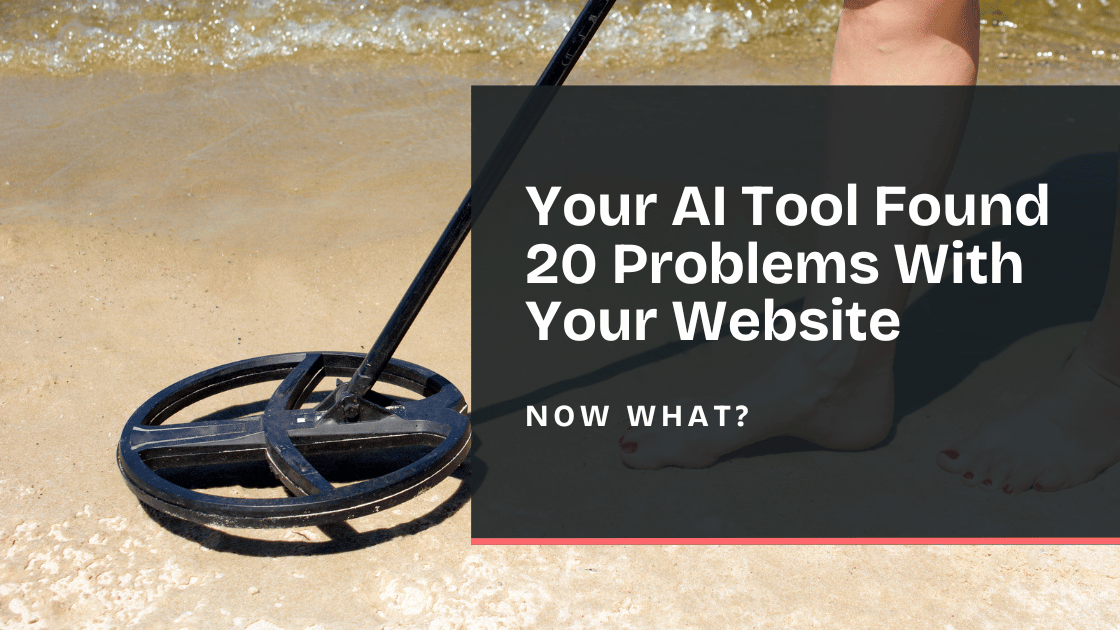
Picture a top-of-the-line metal detector on a public beach.
It works perfectly. It’s sensitive, accurate, and it will beep at every single piece of metal under that sand, which means it beeps constantly. Bottle caps. Pull tabs. Tent pegs. Someone’s car key from 1997.
But the detector can’t tell you which beeps matter. It doesn’t know rings come off at the volleyball court, or that the good stuff is where the towels go and not down by the waterline. It has no theory of how things get lost. It just beeps.
That theory has to come from somewhere else. It comes from knowing everything about the beach: where people sit, how they move, what they were doing when they lost the thing in the first place.
Here’s the useful part. You already know your beach. You know who buys from you and who never does. You know which questions come up on every call. You know the objection you get so often you’ve started answering it before anyone asks.
The tool knows none of that. It has the information it has access to and nothing else. So when it hands you twenty beeps, some of them are real and most of them are bottle caps, and it can’t reliably tell you which is which. Not because it’s a bad tool. Because it’s standing on the beach with no idea what got lost there.
The question that separates a finding from a decision
Take any single item off your AI’s list and ask:
What would have to be true for this to matter?
Your tool says users are dropping off on your pricing page. Okay. Why might that be happening?
- The price is too high for what you’ve communicated so far.
- The price is too low so people think it’s not a valuable offer.
- The page is confusing and people can’t work out what they’d actually pay or hesitate because there isn’t a guarantee.
- The wrong people are arriving. Your ads promised cheap, your page says premium.
- The real problem is upstream, on a homepage that makes promises the pricing page doesn’t live up to.
- Nothing is wrong. Pricing is exactly where unqualified visitors should leave.
Five interpretations. Five completely different actions. And the drop-off number is identical in all five cases.
The answer isn’t in your analytics. It’s in what you know about your customers, your margins, your traffic sources, and what you’ve already tried. AI can’t reach any of that. It’s working from the beeps.
So before you touch anything on that list, force each item through three filters:
1. What would have to be true for this to be the real problem?
Write it down. If you can’t articulate the mechanism, people leave because ___, then you don’t have a hypothesis. You have a beep.
2. If I fixed this perfectly, how much money would it make?
Not “would it improve.” How much. A 2% lift on a page 40 people see a month is a rounding error. A 2% lift on your checkout might be your quarter. Do the arithmetic before you do the work.
3. Is the evidence for this actually on the page?
This is the one people miss. Some conversion problems aren’t page problems. They’re positioning problems, or traffic-quality problems, or offer problems. You can analyze a page forever and never find them, because the evidence was never there.
Anything that survives all three is worth the effort. Most items won’t survive the second question. That’s not a failure of the tool. That’s the tool doing its job, and you doing yours.
“Can’t the AI just rank them for me?”
It can. Most tools already do. You’ll get impact scores, effort scores, a confident top three.
But that doesn’t answer the question you actually have. It replaces it with a new one:
Do I trust this recommendation and ranking?
You still have to make the call yourself. It just arrives looking like it’s already been made. AI is more confident than a toddler telling you they are not tired.
A ranking is a judgment with a number attached. To rank your pricing page as “high impact,” something has to know the full context: your margin, your traffic volume, your average order value, what your competitors charge, and the fact that you tried a version of this exact fix eighteen months ago and it went badly. The tool has none of that. For the most part, it’s still guessing.
And the detailed recommendation that AI typically guves makes it harder to argue with, not easier. A vague suggestion invites a second opinion. “Impact: 8.4” doesn’t.
Now, you can fix a lot of this. Give it the context. Tell it your margins, your volumes, your history, who your customer actually is. The recommendations get meaningfully better, and I’d encourage you to do exactly that.
But to know whether the new recommendation is any good, you need a rough sense of what the right recommendation looks like. If you have that, the recommendation is a useful accelerant. If you don’t, you’ve just made a guess more persuasive, and you’ll dig where it points.
That’s the actual risk with AI here.
The risk isn’t that it will give you bad answers, it’s that it will give you a lot of confident ones.
Why this matters more for small businesses, not less
If you’re running a small business with a membership site, ecommerce site, a service getting leads, or a SaaS platform, you have a specific constraint that changes everything: you don’t have the traffic to be wrong very often.
A big company can run twelve tests, have nine of them fail, and learn something. That’s a fine trade when you’ve got 200,000 visitors a month. When you’ve got 2,000, each test takes weeks to reach anything close to a readable result, and a “winner” at that volume is often just noise wearing a nice outfit.
Which means your scarce resource was never ideas. AI just made ideas free.
Your scarce resource is attempts. You get a handful of real shots a year.
Spending them on bottle caps is the expensive effort, and it’s the one the long confident list encourages.
The short version
AI made it cheap to find things. It did not make it cheap to be right.
Use the AI tools. Seriously, use them, they’re very good. Let the tools read your reviews and your recordings and your analytics. Let it hand you the beeps.
Then do the part it can’t: decide which holes are worth digging.
Not sure which of yours are worth digging?
Each month I do a small number of free Conversion Leak Diagnoses: a short video walkthrough where I go through your site and tell you the one or two things actually costing you conversions, and why. Not a list of twenty. The two or three that matter.
Request a Conversion Leak Diagnosis →
Frequently Asked Questions
1. Can AI improve your website conversion rate?
AI can improve your conversion rate indirectly, by finding patterns in your data faster than a human can. It cannot decide which findings matter for your business. AI produces findings; conversion lift comes from choosing the right ones to act on.
2. What is AI good at in conversion rate optimization?
AI is good at speed and scale and finding patterns: reading hundreds of survey responses, reviewing session recordings, and spotting patterns across large analytics datasets. It compresses days of analysis into minutes. What it cannot do is judge which patterns are worth acting on for your specific business.
3. Can AI tell me which website problems to fix first?
AI can rank problems, but it ranks using data it doesn’t have. It doesn’t know your margins, traffic volume, average order value, or what you’ve already tested. The ranking looks precise because it has a number attached, but it’s still a guess.
4. Why do AI website audits produce so many recommendations?
AI audits flag everything detectable, not everything important. Contrast ratios, form fields, load times, and page drop-offs are all easy to detect automatically, so they all appear. Detectability and business impact are unrelated, which is why most items on a 20-point list aren’t worth fixing.
5. How do I know if an AI recommendation is worth acting on?
Run it through three questions. First: what would have to be true for this to be the real problem? Second: if fixed perfectly, how much money would it make? Third: is the evidence actually on the page? Most recommendations fail the second question.
6. Is AI-driven A/B testing reliable for small businesses?
AI-driven testing is less reliable for small businesses because of traffic volume, not the AI. With a few thousand monthly visitors, tests take weeks to reach a readable result, and apparent “winners” are often statistical noise. Low-traffic sites need fewer, better-chosen tests, not more tests.
7. Will AI replace conversion rate optimization experts?
AI has not replaced optimization experts because the bottleneck was never generating ideas. It was deciding which ideas deserve your limited traffic and testing time. AI made ideas nearly free, which makes prioritization and interpretation more valuable, not less.
8. What is the biggest risk of using AI for website optimization?
The biggest risk is confidence, not inaccuracy. AI presents guesses as scored, ranked recommendations, which makes them harder to question. Businesses then spend their limited testing capacity on changes that were never going to move revenue.